by Angela Taffs | May 10, 2016 | Sales and Marketing
Are you struggling to attract enough quality prospects to your business?
Follow my top tips to start to get those ideal clients queuing up to find out more about you.
Create a plan – don’t just work ad hoc
Fail to plan, plan to fail. I use that adage a lot as it is so true. If you just stick your finger in the wind and hope something will work if you throw enough out there, you are likely to waste an awful lot of time and effort. Have a structured plan of exactly what you want to achieve over a specified time period. You can then prepare the right number of messages to the right audience in the right marketing channels that will significantly increase your chance of success.
How many prospects do you want?
If you want to gain 5 new clients this month and you know you gain one client out of every 5 calls you make, then you need to speak to 20 warm prospects. And then if you know that you get 1 warm prospect out of every 5 prospects you engage with, you will need to find 100 new prospects this month.
Now you have a clear number to aim for and plan to achieve rather than just aimlessly trying to get as many as you can.
Where do they hang out?
Where do your prospects hang out or go to find a solution to the problem you can solve for them? Is it online or offline, or a mix of both. Wherever it is, you need to find out and be there with your message.
If it is social media, are you sure which channels you should be on? Rather than just blindly follow the crowd with the major players such as Facebook and Twitter, do some research on others such as Snapchat and Periscope and see if your prospects are hanging out there and asking questions. This could be a better use of your time than trying to break through the ‘noise’ of over saturated options.
Create messages that talk directly to your prospects
You need to be talking in the same language that your prospects use. By this, I mean using the same keywords and phrases that they use as if they see these in your marketing message, they are more likely to resonate with the words and take notice. Start to join in groups and forums and take note of how questions are asked and what words and phrases are used. Use questions as a starting point for your marketing message by creating a message that helps answer it or gives tips as to how to solve the problem posed.
Be consistent and persistent
There is no point putting your message out there a couple of time and then giving up because you didn’t get a response. It takes time, particularly online. You need to be persistent and consistent to raise your visibility. Just because your post something in a Facebook group or on your page and you know it is there does not mean that many others will see it. There are hundreds of thousands of other messages out there and if you prospect isn’t reading at the right time, your message may easily get missed as it will have dropped down the news feed.
If you are networking face to face people will take time to get to know you and find out what you are about. You can’t expect to go to one meeting and sign up new prospects immediately. They will want to see that you are there for the long run and not about to disappear after just one session.
Get prospects to engage in conversations
Once you have the attention of your prospect, get them to engage with you in a conversation so that you start to build a relationship and trust. Ask questions to get to know them better and find out how you can help them, whether online or offline. Ask them to complete a survey, again to find out more about them and to help identify a solution for them. Offer some free advice to build trust and awareness of what you can do for them. This way you keep them engaged and interested in talking to you so you can build a future relationship.
Stick with it
Following on from being persistent and consistent, allow your marketing to take time. You may be surprised just how many people are quietly watching you and taking an interest. When the time is right, if your message and offering is right, they will get in contact with you or engage in a conversation. But if you give up too easily, they will soon find someone else to take your place.

by Angela Taffs | Apr 12, 2016 | Business Success, Customer service
Have you ever had a complaint on social media?
Today, more and more people take to social media to make a complaint. But there is such a huge difference in how businesses deal with these complaints.
If you get a complaint on social media, do you want to keep that client who complains (and create a raving superfan for your business) or just get rid of them (and take others with them)?
Things go wrong. If they don’t, you probably aren’t that busy or aren’t trying hard enough.
[Tweet “Things go wrong. If they don’t, you probably aren’t that busy or aren’t trying hard enough.”]
And this past week two retail giants had major problems. Their websites broke! Sainsbury’s was online but whatever search went in ended in ‘no results’ available. Boots UK site was completely down and simply couldn’t be accessed.
Sod’s law dictated these problems happened on the very day that I was trying to do some online ordering. After numerous frustrated attempts to order what I wanted, I gave up and took to Twitter to ask when they would have their problems rectified.
Within minutes of my tweet to Sainsbury’s, they responded to say they had checked and yes, there was a problem and would report back to me. In a short while, they tweeted me again to say they were doing their best to rectify the problem and would I bear with them and try to order in a few hours time.
Boots? The silence was deafening! No response at all.
Later that evening Sainsbury’s asked if I would send them a contact number so they could speak to me direct. I duly sent this and they called me to say the site was back up and had I managed to place my order. I told them that I hadn’t placed my order as time had run out and I had gone elsewhere. They apologised profusely for the inconvenience caused, told me how much they valued my custom and immediately sent me an e-voucher.
I was impressed.
Boots? After sending a second tweet they responded 48 hours later to say their site had only been down for one hour. Utter rubbish, it was down for over 6 hours! And no further correspondence was had from them.
So what can you learn from these two companies and the way they handled a problem? As I am sure you can guess, it’s not rocket science.
What to do when you get a complaint on social media
If you get a complaint or a client/customer flags up a problem try the following:
- Immediately acknowledge there is a problem and it will be looked into
- Ask for contact details to take the complaint off line
- Inform the client of when they can expect a response
- Respond
- Let them know what went wrong and what has been done to rectify the problem
- If you and your business were not at fault, there has still been a misunderstanding of some sort so acknowledge this and look into ways of ensuring the misunderstanding or problem does not happen again
- Let them know how much you value their custom and apologise for inconvenience caused
- Go over and above to make them feel special and offer them a freebie/voucher or similar to show you genuinely care
This is an effective way of regaining trust and credibility with the client and retaining their custom.
It is also possible they will be so impressed that they will turn back to social media to say how impressed they were with how your problem was handled, raising awareness of your business to others.
What not to do when you get a complaint on social media:
- Ignore them
- Deny there was a problem – this is basically calling them a liar – not recommended as insult will be taken
- Get into a public argument
- Do absolutely nothing to let them know you value their custom
If you do the above, you are most likely to lose their custom forever (there are plenty of other places to buy the same products and services from).
It is also quite probable that the client will take to social media to highlight your poor attitude giving a bad impression of your business to others who may have been thinking of buying from you and will now go look elsewhere.
Create a customer care policy
If you don’t have a customer care policy in place, go create one now. It doesn’t matter if you are a one woman band or a multi-million corporation. The principle is exactly the same.
Hopefully, you will never have to use it but as the boy scouts famously state, it is always good to be prepared.

by Angela Taffs | Apr 4, 2016 | Running a Business, Sales and Marketing
Social media friend or foe
For those of you who have got to know me, you will be very much aware by now that I am a stickler for social media etiquette as illustrated in many of my previous posts such as ‘A key tactic when your content is shared on social media’
In my opinion, far too many lose sight of the word ‘social’ when using social media. They rely on autoresponders to send messages to followers on Twitter and use auto-scheduling software such as Hootsuite and Buffer to post out messages but then fail to check in to reply to comments or questions.
Well Jeeves, it simply is not good enough.
And now there seems to be another abhorrent trend doing the rounds. This has become apparent on Facebook where certain people feel the need to send a personal friend request to some poor unsuspecting victim to then, once the friend request has been accepted, automatically add them to a group without their permission only to bombard them with sales messages.
Jolly bad practice!! And personally, I think Facebook should look into banning it.
I am selective as to who I accept as a friend as I prefer to keep my personal and professional life separate. But on occasions, where I have built a relationship with someone in a group, then yes, I also will accept them as a friend.
But if they are then so rude as to add me to their group with no explanation or introduction it just illustrates to me what an unprofessional person they are and one that I never want to do business with. They have used an unscrupulous practice to entice me as a social media friend under false pretences.
Due to my selectiveness with my friends, this has only happened to me on a couple of occasions but I know of others who have been bombarded with newfound ‘friends’ not only adding them to wholly unsuitable groups but also posting on their own personal walls!
This is the height of bad manners and I suspect started from some low-level MLM pundit or desperate business coach (and before you start I am not anti-MLM, far from it as there are a few very good companies out there). It is exactly the same as me accepting to meet a new friend for a coffee only to be taken completely unexpectedly to a timeshare talk. Not the way someone should treat a friend in any way, shape or form.
Which are you? A social media friend or foe?
If you are an offender and guilty of this practice may I suggest you cease it now? There are far better ways to market your services and this is not one of them. You will only end up getting yourself a bad name and believe me, bad news travels fast.

by Angela Taffs | Mar 25, 2016 | Sales and Marketing
Guest blog from Vicki Nicolson
Vicki Nicolson Branding Therapy
When you first started out in business I bet you thought, right, I’ll press my publish button on my Facebook page, launch my site, set up all my different social media accounts and then BOOM I’ll get loads of clients. And as soon as you did all this you got a few likes from friends and well wishes but not actual paying customers, am I right?
So here’s the thing when it comes to your lovely business, you really are the only one who cares about it more than anyone else. You are your biggest fan because you believe that you can do great things, change people’s lives and make a real difference. So why aren’t you telling anyone? Why are you sitting looking at competitor websites, pages and posts? Whilst in the back of your mind there is a little voice telling you, OH MY GOD THIS IS NEVER GONNA WORK, YOU ARE CRAP and YOU CAN NOT DO THIS.
This is called being normal! Brands build their reputation and recognition over time. There is no such thing as an overnight success. Speak to anyone in business and they will tell you the same thing. Crickey, Apple were literally on the verge of going bankrupt until Steve Jobs returned to Apple. They had to work mighty hard to get to where there are now.
So how can you too become a brand magnet and stand out from the crowd? Here are my 3 simple steps to help to magnetise your brand and supercharge your business.
Step #1 – BE YOU
Your brand is all about personality. You know already what makes you different but sometimes we just don’t have the guts to show our true colours and confidence holds us back. Find something you love doing, be YOU and be consistent and I guarantee you will feel more at ease with your brand and your biz.
So just be YOU. That is the one piece of advice I give on a daily basis. Stick your name in your biz name. This is key advice, especially for the coaching market. Right now I see a lot of coaches entering the market, using your own name makes you unique and will make you stand out in an overcrowded marketplace. Sticking you name right in there in your business also makes you look passionate about your business too. You love it so god damn much you put your name to it. This also works, especially if it is just you in the business.
Write your copy for your site the way you want to. Post on your FB page when you want and not on the basis of your insights – I get way more engagement when I don’t even take notice of my insights stats. And tell your brand story – tell people how you came up with your business idea, what your passion is and how you help them. People are intrigued by how you can help them. The whole brand building process is about building an emotional connection with you so that ultimately they buy from you.
Step #2 – Use eye-catching images and don’t blend in
First impressions matter – it takes milliseconds for your potential customers to form an opinion about your website, logo and visual branding, font, colours, spacing, symmetry etc so your brand image is everything.
Using eye-catching brand images will enhance your brand’s image ten-fold. I know the hard part can be finding just the ‘right’ image for your meme, Facebook cover or brochure but the biggest secret behind captivating your audience is to follow some of my simple basic steps to help you pull some images together fast.
- Try to choose images based on the relevance of what you are posting and writing about.
- Don’t blend in. So for instance, if you sell ethical products then it would be obvious to use all things green and eco related right? WRONG! Go down a different path, choose a different colour, like pink with a use of teal and yellow instead, and images of laughing women seem to get the most engagement on my own Facebook page. Try it and see.
- Use quirky images that pop and don’t just copy and paste other people’s quotes when you are posting memes, find your own voice and write your own quotes based on your own opinions.
- Use well-composed images that ooze greatness and that are well thought out.
Overall think about the emotion you are trying to communicate. How do you want you tribe to feel? You want to build an emotional connection with your brand, how will you communicate that?
Step #3 – Professionally brand yourself
We’re all drawn to visual gorgeousness. It attracts interest and it creates desire for something. If you want to make more money in your business right now then you need to create an exciting and irresistible brand identity for your biz. A well-developed brand identity is key for clients and customers in their decision making process. According to Google research, users spend most time focusing on your logo before moving on within a website – it’s 6.48 seconds – yup that’s more time than anywhere else on your site! Yikes! You literally have seconds to win them over. 94% of first impressions are design related. Google research, overall, said this, “invest in design – it’s what matters the most for pulling users in.”
The benefits of having a good logo are tenfold:
- It makes you look established, bigger, committed and reputable
- Conveys you are professional
- It explains your company name
- You will stand out from others in a similar field or explains an unusual line of business
It’s a no brainer to get yourself a good logo and consistent branding across all your marketing materials and that includes things like photoshoots, your office space and even down to what specific piece of clothing you wear. I am known for my love of all things pink – I wear a lot of pink. So my brand is pink. Nails are painted pink… Professional branding identity will boost your business and your confidence.
Once you nail these simple steps you will start to ask yourself, how can I do more with my brand?
Your brand will evolve over time but you need to be committed, consistent, be your biggest fan and be hands on in your brand. It needs daily maintenance, it needs love and your customers need to be engaged. So be prepared to look after your brand. Post every day, mingle in groups, get your name out there, be the expert, stand out from the crowd and be in it for the long haul and I guarantee it will supercharge your sales.
Author
 Vicki is a creative branding stylist, designing magnetic branding for women in business throughout the world.
Vicki has two decades of graphics, marketing and communications expertise. She enjoyed a lucrative career working as an in-house designer for international corporations and when her son turned four she decided it was time to take the leap and follow her dream of running her own business.
Using her power of creativity Vicki helps women stand out from the crowd by branding businesses in such a way to target desired clients and help convert customers into paying ones.
For more information visit: https://www.vickinicolson.com/

by Angela Taffs | Mar 22, 2016 | Business Success, Sales and Marketing
Top tips to create a survey online
- What is your objective
Decide what you want and why you want to create a survey in the first place. Have a clear objective as to what information you want to get from the results.
Do you want to know what they think of an existing product? Do you want to know what they love about you so you can use this in your future marketing message? Do you want to know what frustrations clients have so you can look to add a new product or service to help them?
- Who is your target audience
Know exactly who you want to the answers from. In other words, who is your target audience. There is no point getting teenage girls to answer a survey about anti ageing products.
Identify your target market clearly and in your opening statement make it clear to only complete if they fit the mix.
If you are a woman over 40 who cares about her appearance and would like to keep your skin as youthful as possible for a long as possible, please complete my survey and be in with a chance of winning a sample pack of my new product
- Let your audience know how much time the survey will take.
If they know it will only take 2 minutes, then tell them. If it is going to take them 15 minutes, let them know and tell them to go grab a coffee. There is nothing more frustrating than getting to question 6 with no idea of how many more questions there are and how long it is going to take. Many people (including myself) will simply give up if they think it is going to take too long so set expectations at the beginning.
- Give an incentive
You are asking people to give up their valuable time so incentivise them to help you out. When you create a survey, offer a prize draw to win one of your products or a complimentary session if you sell a service. Everyone loves to think they are in with a chance of winning and if you have targeted your audience correctly, they are going to want what you are offering.
- Keep in short and sweet
Leading on from point number 3, short surveys get the best response unless there is a golden incentive for giving up longer periods of life to complete more in-depth ones. I always try to stick to 10 questions maximum as this is enough to glean the information I want and to not overwhelm the respondent.
- Keep it simple
Keep questions as simple as possible. Don’t overwhelm respondents by asking them to describe in detail a situation/feeling/opinion. This is going to take them time and thought which may put them off. If you have one area that you really would like to know more about, leave it until the end. Have the simple questions that they can get through quickly at the beginning and keep anything more detailed for last.
For simple questions, use multiple choice or checklists.
- Don’t use closed questions
Closed questions give a yes or no answer so should be used sparingly. Asking someone ‘Do you love our products’ is closed and can only be answered with a yes or no which doesn’t really give you any valuable information.
Ask open questions such as ‘What do you love most about our product/service?’ followed by another question of ‘what one thing could we do to improve our product/service?’. This will give you much better insight into vital information to help your business.
- Gather email addresses
Ask people to give their email address and by offering an incentive as in point 3, this is an easy way to get them to hand it over. However, don’t make it compulsory. The survey is to gain you valuable information and insight for your business and you don’t want to lose people who aren’t willing to give up this information.
You can then add survey respondents to your mailing list or send them a personal message to offer help with a specific problem that they have highlighted in their answers.
- Have a cut-off date
Don’t let the survey run forever. Have a clear cut-off date to collate and analyse answers, and of course, for the competition winner to be decided and announced.
- Promote!
Post your survey wherever you can. Send to your mailing list, post the link in social media groups, send to existing and past clients and all of your prospects.
So there you have it. My top tips to create a survey online that gets results.
If you create a survey that you would like me to share for you, simply come on over to my Facebook group and I will be more than happy to help.

by Angela Taffs | Mar 3, 2016 | Sales and Marketing
How many times do you get an enquiry from a prospect, send them some details and then file them away and hope they get back in touch? Too often I suspect. Some of these prospects could be good potential future clients but they do not receive enough contact to be converted to buying from you.
How many times do you think you should follow up a prospect?
People tend to lead busy lives and if the email you send or voicemail you leave arrives with them at an inconvenient time, they may forget to respond or, be full of intention to, but then something else happens that takes priority. Past research has shown that it can take up to seven touch points with a prospective client before they take action and with the huge rise in social media, this figure can now be significantly higher.
I have included a simple diagram which shows 13 touch points but illustrates how the buying process can take time and most salespeople do not make enough contact to keep in the potential client’s mind. You may not see yourself as a salesperson, but in reality, yes you are if you are trying to gain paying clients.
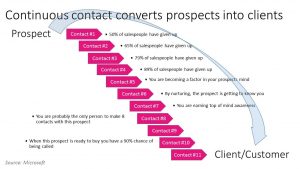
Therefore, you need to set up a system to ensure regular activity to try to make contact and if no response is forthcoming after a set period, to at least add them to your mailing list for an ongoing newsletter (you did take their email didn’t you?).
After someone has requested some information on your business and you have sent it out, a simple seven-point contact plan could be as below. Once a prospect buys from you, they would move out of the remaining sequence and be added to your client mailing list so that ongoing contact is still maintained. The types of contact you have will be determined by the information you have available so at the point of the initial enquiry, get as much information as you can. Ask for an email as the bare minimum but if you can, take a phone number and mailing address.
- Attempt contact via email or phone call to see if info received and if any questions. If no response, leave a message or send acknowledgement email (within 24 hours)
- Follow up call to prospect and if not there, leave a message (+24 hours from step 1)
- Send follow up email (+ 1 week from step 2)
- Send a written letter (+ 1 week from step 3)
- Final phone call (+ 1 month from step 4)
- Final email (+ 1 week from step 5)
- Final letter – confirm no further contact will be made but will add to the mailing list (+ 1 month from step 6)
Once prospects have moved off the main seven steps and on to your mailing list, this database of contacts can be used for sending out your newsletter, free advice, and tips and for future marketing purposes including competitions/surveys etc.
Free Download: Follow up prospect sample worksheet
To access this worksheet, simply leave a comment below