Many small businesses with low risk and lower profits start off as sole traders as it is much easier to set up and the financial administration is much simpler. Moving from a sole trader to a Limited Company can be done at any time, although one of the most common times is when profits start to increase significantly.
Things to consider when considering moving from sole trader to a Limited Company are:
Protect yourself
Are you looking to protect yourself as an individual? Should someone suffer financial loss due to advice you have given, you won’t be personally liable if someone makes a claim against you (the business).
Protect your business name
Do you want to add a level of protection to your business name? This could be a useful move for you as your business brand is growing. Registering a company name at Companies House means that the chosen name cannot be registered by any other business
Profit levels
What are your profit levels? There are a lot more tax benefits to be had by moving to a limited company if you are in a higher tax bracket. If not, you need to weigh up the costs involved with a Limited company against the profits you are making as a sole trader. There used to be a general rule of thumb that if your profits were under £30,000 you would be better off staying as a sole trader. However, this is subject to change and a number of other factors so professional advice from an accountant should be taken.
Administration time
Do bear in mind the increased time and tasks you will need by incorporating your business. End of year accountancy fees will also be higher so if your business is low risk and with profits of under £30,000 you may wish to remain as a sole trader. If you are a sole trader it can be easy to do the end of year accounts yourself but as a Limited Company, I would always advise using an accountant.
Credibility
Another benefit to moving to a Limited company is that it makes your business look more professional and can boost your status to prospective clients. It will also put you in higher stead should you look to raise finance in the future.
Take professional advice
It is strongly recommended to speak to a Chartered Accountant or financial adviser before making a final decision as they will be able to advise on your individual business needs.
Taking the next step from Sole Trader to Limited Company
If you have made the decision to set up as a Limited Company, Gov.uk has a step-by-step guide to help you. This guide includes:
Choosing and registering your business name
Choosing director and a company secretary]
Deciding who the shareholders are
Identifying people with significant control over your company
Preparing a ‘memorandum of association’ and ‘articles of association’
What company records you need to keep
What accounting and financial records you need to keep
Selecting a Standard industrial classification of economic activities (SIC) code
Registering for Corporation Tax
If you need further advice, get in touch if you would like recommendations of Chartered Accountants who will be able to help.
One common reason people start to read your blog post but then leave is due to the reading time. They may be interested in what you have to say but only have a few minutes to spare when they come across it. They start to read, thinking it will only take a couple of minutes but then realise it’s quite an in-depth post and they don’t have enough time. They click off the blog post and may then get distracted and forget to return to it.
The other side of the coin is where people have limited time and think the blog post is going to take 10 minutes to read whereas it’s actually short and sharp and could be read in just 2 minutes.
This can mean a huge loss in potential followers and prospective clients if you have a subscribe to newsletter opt-in at the end of your posts or you have a call to action further down the content.
So how to get over this issue and get people to keep reading your blog to the end?
The easiest way to overcome this problem is to display an estimated reading time on all your blog posts. You can either do this manually by using online calculators and adding the reading time to each blog post or if you have a WordPress website, use a reputable plugin.
A simple online calculator is Read-O-Meter where you simply copy and paste your content and it automatically calculates the estimated reading time.
If you want to make it super easy and have a WordPress website, use a plugin such as Read Meter which I use. It’s super simple to use and it automatically calculates the read time for you. This can then be displayed at the top or bottom of your blog post as shown in the image below and at the top of this post also. I love this plugin as it really is so easy to set up and can be customised with your theme colours.
To make sure you keep getting more wonderful tips like this, make sure you subscribe to the mailing list below.
Your returns policy may be the last contact a customer has with you. And the last contact with a customer is how they remember you. And you want them to remember you for all the right reasons. If a customer buys from you and then has to make a return, make this experience as easy and as streamlined as you possibly can.
The returns experience can dictate whether your customer will buy from you again in the future or not.
I was an avid fan of two separate companies. Over the years I must have spent thousands with them. But no more. And it was all down to their returns policy and the stress this caused.
Both companies went out of their way to make the process as long and arduous as possible. Both companies failed to refund monies owed for a whole 4 weeks!!!
The first company, when I queried when I would get my money refunded quite simply ignored me. So much to the point that I took to social media to call them out and ask why they wouldn’t answer my emails. Their response? They blocked me!!!!
This was like pouring fuel on the fire! I was livid! I wrote to their head office and reported them to trading standards. I got my money back and a pathetic email saying there were delays with refunds. Not good enough. Even though I love their clothes, I will never in a million years buy from them again.
The second company were almost as bad. After returning a rather expensive item, I didn’t get my refund. I phoned and was told they hadn’t received the parcel. Luckily for me, I had paid for the return to be tracked. When I informed them of this, they said I would have to prove it! I duly copied the tracking and sent it to them. They responded and admitted they had received the parcel but only on that day that I had phoned. I could prove this was not the case and pointed out the tracking clearly showed they had the parcel a week ago and at which point they became rather hostile.
It took another 2 weeks for my refund to come through and my emails asking what was happening were ignored. The sad thing is that they had other items I wanted to order but after this awful experience, again, I will never order from them again.
Why companies do this is beyond me. They need to take a leaf out of another companies book that takes a completely different look at the refund process.
This was a company that I had reason to return an item. Firstly, I had the refund within 48 hours! Secondly, they sent me a note to say it made them sad they hadn’t been able to provide me with something I wanted to keep this time around, but come back, order again and they would give me priority delivery for free as a thank you.
What a difference!
I instantly fell in love with this company. I wanted to do business with them again and buy from them. They made me feel valued and that they genuinely wanted my custom.
Why returns can be good for business
At every stage of the buying process, make the effort to impress your customers, not to leave them feeling cheated and uncared for.
No, of course, you don’t want returns coming back to you but it’s far better to allow customers to make returns in the easiest way possible. If they feel your returns process is too difficult, they may hang on to an item they don’t really want and guess what, this will stop them from buying from you again as research has shown.
However, if you make the returns process easy, customers will feel confident in the knowledge they can get their money back if they receive something they don’t love and are more likely to place larger orders because of this. And they are more likely to keep these items that they wouldn’t have otherwise ordered meaning increased sales for you.
So even though you may lose money on the initial purchase, you have a higher chance of recouping those costs in the future.
What does your return policy look like?
Take a hard look at your returns process from a customer point of view.
Does the customer have to pay for the return, or do you cover the cost of this? Yes, there will be a cost to you if you cover the return fee but it can create extra orders for you upfront. Many customers check out the returns policy before buying and won’t even place an order if they have to pay for the return.
How long does it take for you to refund the money to the customer? Don’t play delay tactics here. Make it clear how long it will take for the customer to get their money back. Make it as quick as you can to build trust and confidence.
Do you offer an exchange service for an alternative item? Look for an opportunity to encourage the customer to receive another item for their money rather than a monetary refund. If you don’t offer free returns, consider offering free shipping on exchanges.
What else do you do? If like most companies, I suspect nothing. How about using the example above to turn it into a pleasant experience for the customer and another sales opportunity for you?
Examples of a good and bad returns policy
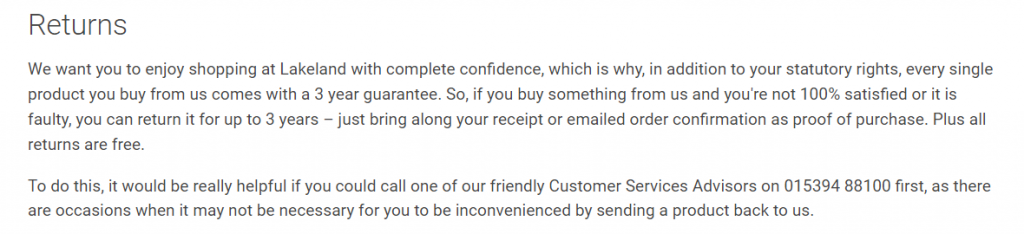
Who wouldn’t feel confident ordering from Lakeland with an incredible 3-year guarantee!!
On the other hand, Next, even though technically Next give the required 28 days to return an item, they state you must inform them you wish to make a return within 14 days! Legally ok but sneaky perhaps? They also make a charge for a return.
Do you have any experiences of a return that is particularly good or bad? Share below in the comments.
Running a business from home isn’t always the easy, relaxed lifestyle that we initially envisaged. All too often little things can build up and leave us feeling stressed and frustrated.
Follow these tops tips to stay stress-free as much as possible when running your business from home.
Keep your calendar organised.
When someone asks you to do something go check your calendar. If you already have something written on there, tell them you are busy. If you have work scheduled, do not double book! It is all too easy for friends and family to think we can drop everything because we work from home. Yes, this is the case if you are running a hobby, but if you are running a professional business, you will give it the time and dedication it deserves and control your calendar accordingly.
If you want to stay stress-free, you need to control your calendar and not let your calendar control you.
Exercise.
Be fit and healthy and always exercise. Remember, just a little is better than nothing and the endorphins that exercise releases can help us stay stress-free. Try simple walking, swimming, cycling, jogging, yoga or an exercise class/DVD. If you can fit this into a morning routine before you start your working day, then all well and good. If not, make sure you get up and move about at regular times during the day and get in at least a 20-minute walk at lunchtime. You will feel so much better for it.
Little and often
This applies both to your business and your home. Breaking your work down into small bite size chunks that you work on regularly can sometimes be better than trying to tackle a mammoth task that leaves you feeling stressed and demotivated. With your home, clean a little every day (I do a short 20 minute burst both morning and evening) to ensure your house is not too dirty which will then require a full day of cleaning at the weekend.
Oh, and if your other half comes in and asks why the house isn’t clean, just show them this picture which I saw recently and made me laugh.
Get work done!
This is a big problem with stressed people. How often have you put off that task that you know needs doing, but you are simply dreading doing? As in Brian Tracey’s book Eat That Frog, do your worst tasks first thing and get it out of the way. You will feel like a weight has been lifted and you will be able to focus on the rest of your work with a feeling of relief. As in the ‘little and often’ tips above, if you a large task to complete that seems overwhelming, stop worrying and start working! Set a timer for 20 minutes and do nothing but focus on the work required. You will be amazed how much you get done.
Don’t argue.
Learn to agree to disagree with your friends and family, or just anyone you are having trouble with. Getting into an argument rarely solves anything. Whether it is someone who is trying to tell you how to run your business, or someone disagreeing with your political, religious or moral views, state your opinion slowly and calmly and then agree to differ. The world would be a boring place if we all agreed on everything all of the time. Don’t waste precious energy trying to change someone else’s opinion to fit with yours.
Control your anger.
Accidents happen. It is not the end of the world if your laptop blows up or you spill coffee over your new notepad. Yes, it might cause disruption and a delay in your work but getting angry will blow it all out of proportion. As the saying goes, don’t cry over spilt milk. Learn to control your anger. Stay calm, count to 10 and deal with the situation. You will feel so much better.
Get on with life.
Breathe slowly and don’t rush your life. Take time to enjoy the here and now. We spend so much time focusing on what we want in the future that all too often we forget to enjoy the simple joys of life in front of us right here and right now.
What tips do you have to stay stress-free when running a business from home? Feel free to share in the comments below.
Are you suffering freelance burnout? Did you even know there was such a thing?
If you are feeling drained, de-motivated and would far rather lie on the sofa binge-watching Netflix all day than turn on your laptop, you may well be suffering freelance burnout.
Over the past few months, the surge in business coaching requests has been incredible! And I’ve noticed a recurring theme running through many of these coaching sessions.
Freelance burnout!
The past 18 months has affected all of us. From those of us who suddenly found our business crashing around our ears due to the lockdown to the other extreme of being so run off our feet, we didn’t know which way to turn.
Whichever end of the scale you were on, we have all had to adjust our businesses in some way or the other and on many it has taken its toll.
Working for a company that makes the decisions and can put you on furlough in a downturn has its advantages in a scenario such as what we have been through. Being a freelancer and having to take the full burden on your own is a huge stress to carry.
At the best of times working alone can take up more time than we expect which impacts on our social life with friends and family. Combine this with suddenly having to adapt your whole business to a wholly unexpected event and the demands can seem unbearable.
This is where freelance burnout comes in.
What is freelance burnout?
Freelance burnout is when we simply become exhausted and fed up with our work. We lose our motivation and constantly feel distanced from what we used to enjoy. The simplest of tasks seem to take forever and we would do anything to be able to stay hidden under the duvet than face another day sat at a desk.
We feel more isolated than ever and feel like we are steadily slipping into a black hole.
When you feel like you are falling into the black hole of freelance burnout, how do you crawl back out again?
How to get out of freelance burnout
Talk to someone.
By sharing your feelings, you can realise you are not alone. This person can bring a new perspective to your situation and help you see how you can tweak what you are doing to start to regain positivity and enjoyment.
As the saying goes, a problem shared is a problem halved and is why I have suddenly become so busy of late. So many have contacted me as they know and trust me to be a sounding board when they need it.
Take time out
I promise you it will be far more productive to shut down for a week and have a clear break than trying to drag yourself through the motions each day. Contact clients to postpone meetings and/or work. Explain you have an unexpected situation that needs dealing with as a priority. Set up an email autoresponder and change your voicemail. And then shut off! No checking emails ‘just in case’. Things will wait and the world will keep turning.
Review your work
Take a good hard look at what you are doing when returning to work. Review your business goals. Are you still on track or have you been side-tracked and now going down a route you don’t feel comfortable with? If this is the case, go back to what you originally planned and adjust to get back on track.
Review your clients
Are you working with clients that drain your energy and who you dread hearing from? If yes, then ditch them! When I first suggest this to my own clients, I get the instant response of ‘I can’t afford to’ or ‘they pay me too much to do that’. But whenever they have taken my advice, they have instantly felt a weight lift from their shoulders which opens them up to attract new clients that they love working with. It can be a difficult decision, but it can be a real game-changer.
Get organised
A muddled workspace creates a muddled mind. If your work is all over the place and you are jumping from one thing to another this is only going to cause stress. Sort your work out. Plan your future diary. Use productivity tools such as CapsuleCRM to help you take back control and get organised. Prioritise your work and plan what you are going to focus on each day the night before – a simple but powerful tip!
Sort your workspace
Following on from the point above, is your desk sinking under a pile of notepads, post-it notes and coffee cups? Give it a declutter. Go through drawers, pen pots and files and get rid of anything now defunct. Give everything a good clean and add some finishing touches such as a favourite picture or new plant. It’s amazing how a clean, fresh workspace can affect our mood.
Outsource
Have you got dragged down trying to do things you hate or take up too much of your valuable time? Then outsource it. Again, I can hear the retorts of ‘I can’t afford it’ but can you afford not to these things are contributing to your burnout and overall health? Spend money wisely and it will ultimately reap rewards by making your workday more efficient and freeing up your time to work on attracting the perfect clients.
Plan ahead for YOU and avoid future freelance burnout
Don’t fall into the trap of thinking you can carry on working and will take a break when you need it. We invariably fail to do this and think we will work just another week and then take a day off, which never happens. Pre-book time off in your calendar and make sure you take this time out. Pre-book a mini-break, a massage or lunch with friends. Create an email to go to clients well in advance to inform them you will be away and to let them know of your cut off for any questions before you take the break.
So, there you have it. If you are suffering freelance burnout, you are most certainly not alone. It is a more common occurrence than many like to admit to. Please don’t suffer alone. Take that first step, admit you need help and use the tips above.
And of course, if I can help in any way, get in touch, and let me know.
This website uses cookies to improve your experience. We'll assume you're ok with this, but you can opt-out if you wish.AcceptRead More
Privacy & Cookies Policy
Privacy Overview
This website uses cookies to improve your experience while you navigate through the website. Out of these cookies, the cookies that are categorized as necessary are stored on your browser as they are as essential for the working of basic functionalities of the website. We also use third-party cookies that help us analyze and understand how you use this website. These cookies will be stored in your browser only with your consent. You also have the option to opt-out of these cookies. But opting out of some of these cookies may have an effect on your browsing experience.
Necessary cookies are absolutely essential for the website to function properly. This category only includes cookies that ensures basic functionalities and security features of the website. These cookies do not store any personal information.
Any cookies that may not be particularly necessary for the website to function and is used specifically to collect user personal data via analytics, ads, other embedded contents are termed as non-necessary cookies. It is mandatory to procure user consent prior to running these cookies on your website.